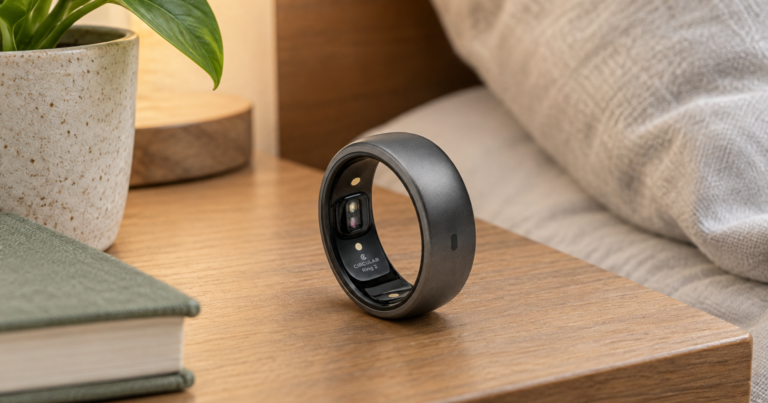

A ring can collect overnight trends while your phone stays on the nightstand and your wrist stays free. For many people, screen-free health tracking feels calmer because the device gathers data quietly instead of turning every glance into another invitation to tap, scroll, or compare.
That calm matters. The value of a smart ring is not that it makes health data more dramatic; it is that it can make useful signals easier to notice without adding another bright rectangle to your routine.
Essential health-tracking smart ring with no required subscription
Diagnosis, treatment decisions, and interpretation of concerning symptoms should be handled by a qualified healthcare professional in line with applicable clinical standards and local regulations.
The short version
A screenless wearable changes the relationship between you and your data. A smartwatch often puts metrics, alerts, workouts, messages, and app prompts in the same place. A smart ring usually does one quieter job: collect passive signals such as sleep timing, heart rate patterns, movement, and temperature trends, then let you review them when you choose.
- Less interruption: no watch face, notification stack, or always-available app grid on your body.
- Better overnight comfort for some people: a ring can feel less bulky than a wrist device in bed, though fit varies by finger and person.
- More reflective use: ring data is often checked in a morning or weekly review instead of repeatedly during the day.
- Fewer identity trade-offs: you can wear a traditional watch, no watch, or a dressier look while still collecting health trends.
- Still not magic: smart rings estimate wellness patterns; they do not diagnose conditions or guarantee better sleep, recovery, or performance.
Calm comes from fewer decision points
Displays are useful. They show the time, start workouts quickly, and put notifications where you cannot miss them. The downside is that every glance can become a decision point: clear this alert, check that metric, answer this message, open that app.
A smart ring removes most of those micro-decisions. It does not ask you to interact while you are in a meeting, walking between errands, eating dinner, or trying to fall asleep. That lack of immediacy is part of the appeal. The ring can be present without acting like a tiny command center.
This is especially helpful for people who want recovery and sleep awareness without feeling like they are on call to their own dashboard all day. You can still care about heart rate variability, resting heart rate, bedtime consistency, and readiness scores. You simply do not have to carry those numbers on your wrist as a live feed.
Smart rings make tracking feel more passive
The best use of a smart ring is often passive and boring in the nicest possible way. Put it on, keep it charged, wear it consistently, and let patterns build over time. The interesting part comes later, when you compare trends with how you actually felt.
That passive style works well for questions like:
- Did a later bedtime line up with a lower recovery score the next morning?
- Do travel days tend to shift sleep timing or resting heart rate?
- Does a hard workout affect sleep quality the same night or the night after?
- Are temperature trends unusually elevated after a disrupted week?
- Does caffeine timing seem to affect bedtime or overnight restlessness?
None of those questions require a live display. They require consistent data, useful context, and enough patience to look at trends instead of reacting to one bad night.
The display problem is not just brightness
It is easy to blame screens only on blue light or bedtime brightness, but the calmer feeling goes deeper than that. A display invites checking. Checking invites comparison. Comparison can turn a recovery score into a verdict on your day before you have even had breakfast.
Smart rings can reduce that pressure because they move the review moment into an app you open deliberately. That does not automatically make the experience healthy or balanced; you can still over-check any metric. But the form factor creates a little more friction between the body signal and the emotional reaction.
That small delay is useful. It gives you room to ask better questions: How do I feel? Did I sleep enough? Was last night unusual? Is this part of a pattern, or just one messy data point after a late meal, a delayed flight, or a stressful workday?
What a ring can and cannot tell you
A smart ring can measure or estimate certain signals from sensors worn on the finger. Depending on the model, those may include heart rate, movement, skin temperature trends, blood oxygen-related estimates, sleep stages, or recovery-style scores. The exact feature set varies by product, app, firmware, and region.
The important distinction is this: a ring is a trend tool, not a medical conclusion machine. It can help you notice changes in sleep timing, recovery patterns, and routine consistency. It cannot tell you with certainty why a change happened, and it should not replace medical evaluation when symptoms or health concerns are present.
That is why the calmest way to use ring data is to pair it with a short human note. “Late dinner,” “hard run,” “hotel sleep,” “stressful deadline,” or “felt great despite low score” can make the numbers more useful. The note keeps your lived experience next to the sensor estimate.
Why the ring form feels different day to day
A wrist device competes with watches, cuffs, sleeves, workouts, desks, and sleep positions. A ring has its own fit challenges, but once the size is right, many users find it easier to forget during ordinary routines.
That low-friction quality changes behavior. When a tracker feels like part of the background, you are more likely to collect a steady baseline. Baseline matters because recovery and sleep trends are most useful when they reflect your normal life rather than a few enthusiastic days after unboxing.
Fit still deserves real attention. Fingers change with temperature, hydration, sleep, exercise, and travel. A ring that feels perfect at noon can feel tighter overnight, while a loose ring may shift enough to affect comfort or sensor contact. The calmer experience starts with a size you can wear consistently, not the size that only works for one part of the day.
Where smart rings beat another display
Sleep tracking without wrist bulk
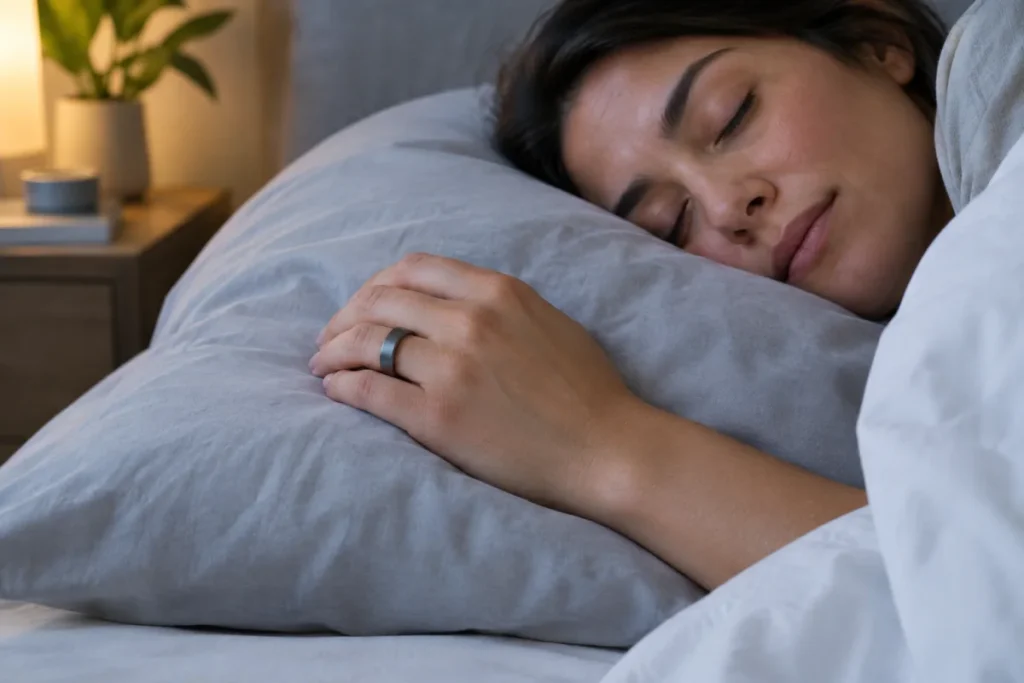
For many readers, sleep is the main reason to consider a ring. A screenless ring does not light up, buzz with messages, or press like a watch case under a pillow. It can collect overnight data while staying physically and mentally quieter.
Recovery awareness without constant coaching
Recovery scores can be useful, but they are best treated as prompts rather than commands. A ring helps when you want a morning signal that says, “Look at the trend,” not a day-long stream of reminders telling you who to be.
A cleaner style choice
Some people love smartwatches. Others want to wear a mechanical watch, a fitness band only during workouts, or nothing on the wrist at all. A smart ring keeps the tracker smaller and less visually central.
Travel and work routines
During travel, presentations, client meetings, or focused work blocks, fewer visible alerts can be a relief. The ring keeps collecting background signals while your attention stays with the task in front of you.
Where a display still wins
Screen-free is not automatically better for every job. If you want turn-by-turn directions on your wrist, live workout metrics, quick replies, timers, music controls, or safety features tied to a watch interface, a smartwatch may be the better primary device.
The calmer choice depends on the role you want the wearable to play. A ring is strongest as a passive tracker for sleep, recovery, and daily rhythm awareness. A watch is stronger as an interactive tool. Many people can use both: a ring for overnight and baseline trends, a watch for workouts and on-wrist utility.
Choosing a calmer setup
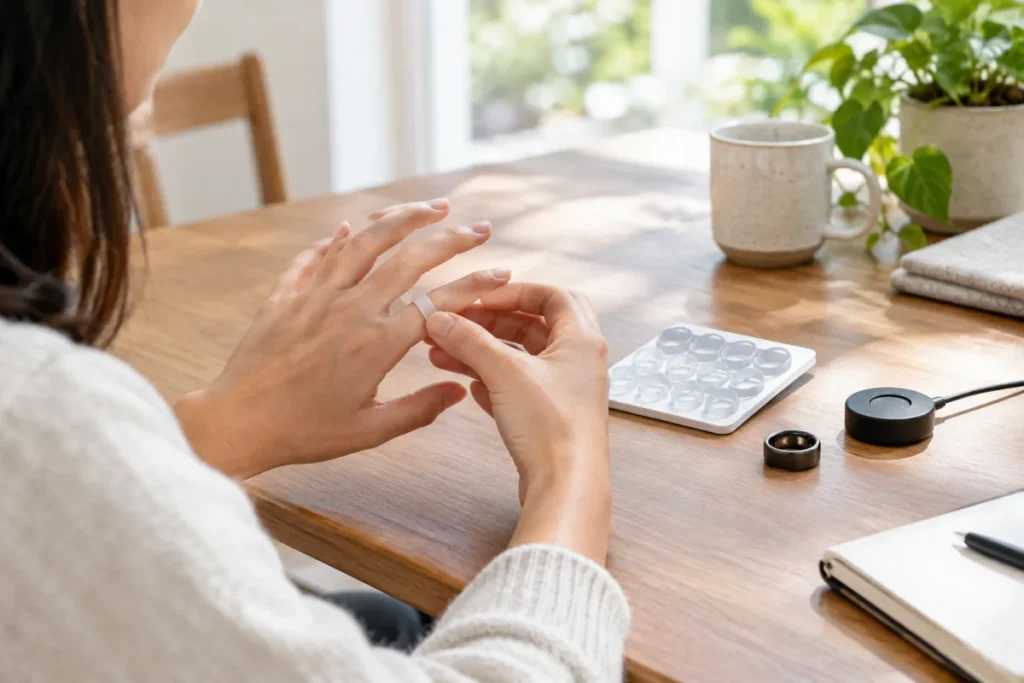
If you are comparing rings, do not start with the flashiest score name. Start with ownership basics: sizing method, phone compatibility, subscription model, claimed battery life, comfort, charging style, data presentation, and whether the app explains trends in a way you will actually use. The Smart Ring Comparison Hub is built around those real ownership factors rather than a single headline feature.
For ecosystem-focused shoppers, the Samsung Galaxy Ring is worth comparing because it shows how a ring can fit into a broader device setup without becoming another wrist display. For readers who want to keep recurring costs low, the RingConn Gen 2 Air is also a relevant comparison point because it is positioned around essential tracking without a required subscription.
Before buying any ring, verify current compatibility, subscription terms, sizing process, water-resistance language, and app features directly from the maker or a current product page. These details change, and they matter more in daily use than a polished launch demo.
A calmer way to use the data
The device is only half the experience. The rest is how you read the information. A useful ring routine can be simple:
- Check once in the morning: glance at sleep timing, recovery indicators, and anything unusual.
- Add one short note: capture the context the ring cannot know, such as stress, alcohol, travel, illness, soreness, or a late workout.
- Wait for patterns: avoid changing your routine because of one odd score.
- Review weekly: look for repeatable links between habits and how you feel.
- Keep body awareness first: use the score as a prompt, not the final authority.
This approach preserves the best part of wearable tracking: gentle feedback that helps you learn. It also avoids the trap of turning every morning into a performance review.
Straight answers
Is a smart ring less stressful than a smartwatch?
It can be, if your stress comes from notifications, display checking, or feeling watched by your own metrics. A ring removes the screen and most real-time interactions, but the app experience still matters. A cluttered app or overemphasis on daily scores can feel noisy even without a display.
Can a ring replace a smartwatch?
For passive sleep and recovery awareness, possibly. For live workout controls, messaging, maps, timers, and glanceable notifications, usually not. The better question is whether you want your wearable to be a quiet observer or an active interface.
Does no screen mean better health data?
No. Sensor quality, fit, algorithm design, app interpretation, and consistent wear all matter. No screen mainly changes attention and behavior. It can make the tracking experience calmer, but it does not automatically make the data more accurate.
Key takeaways
The appeal of screen-free health tracking is not that it hides information. It changes the timing and emotional texture of that information. A smart ring can collect signals quietly, let you review them on your terms, and support better trend awareness without adding another display to your body.
That makes the category especially appealing if you want sleep and recovery insight, prefer fewer notifications, or like the idea of a wearable that blends into ordinary life. Choose carefully, size patiently, and let the data become a steady background signal rather than the loudest voice in the room.